Why audits can change before they happen
Audit incentive effect shifts behaviour before any audit occurs, because the anticipated inspection changes what people choose to hide or report.
Intuition test — answer before you read on
Why can announced audits change conduct before the visit?
At a warehouse, the inspection schedule is posted for everyone to see. Nothing has changed in the room itself: the shelves are the same, the forms are the same, and the supervisor has not yet entered. But the records start to tighten. Waste is reported more carefully, small shortcuts disappear, and the number of questionable decisions falls before the audit arrives. The effect is not produced by the inspector’s visit alone. It comes from anticipation. The audit incentive effect is subtle because the mechanism acts in advance. The possibility of scrutiny changes behaviour even when no one is currently watching.
What everyone sees
What everyone sees is straightforward deterrence. If there is a chance of inspection, people should behave better. The audit is imagined as a flashlight: once it comes on, misconduct becomes visible and punishment follows. That picture is correct as far as it goes. The harder part is that the flashlight also changes the room before it is switched on. People sort tasks, adjust timing, and decide what is worth risking. In organisations, a visible audit regime can reduce bad behaviour, but it can also distort reporting, encourage defensive documentation, and push activity into areas that are harder to inspect. The system becomes partly about the work and partly about the anticipated witness.
What is actually happening
What is actually happening is an incentive response to expected verification. Audits are not just detection devices; they are commitment devices that alter the cost of hiding. Because the risk of being caught enters the decision before any inspection occurs, people re-optimise their behaviour in advance. That is why the effect can appear even in periods without direct oversight. The literature on monitoring and enforcement consistently shows this pattern across tax compliance, workplace reporting, and regulated industries. The precise outcome depends on the likelihood of detection, the size of the penalty, and how easy it is to manipulate what gets documented. Where verification is incomplete, audit pressure can improve visible compliance while worsening hidden behaviour, a classic measurement problem in incentive design. In other words, the audit changes the choice set before the inspection date exists.
Why it stays hidden
The hidden part is timing. Most people think incentives act only at the moment of reward or punishment. In fact, the expectation of later review can become the real operating force. That is why some teams clean up just before month-end and some records become suspiciously neat right after a review cycle is announced. The other hidden part is substitution. If only certain outputs are audited, workers may shift effort into what is audited and away from what is not. The audit then changes the shape of the work, not merely its honesty. That is why any serious audit policy has to ask what it will leave in shadow. In a hard system, the future observer is already inside the present decision.
Audit incentive effect and anticipatory compliance
Anticipatory compliance is the key idea. Once people believe a report, ledger, or process may be checked later, they change the work before the check happens. The response can be useful, because it discourages opportunism.
But it can also be cosmetic. If only the inspected variables matter, people may polish the record rather than improve the underlying performance. The incentive is then aimed at the appearance of compliance.
When detection improves behaviour and when it warps it
Audits work best when the measured variable tracks the real goal closely. If the inspection is easy to anticipate but hard to game, the behaviour shift is constructive. If it is easy to game, the audit can drive concealment into neighbouring categories.
That is why enforcement design is inseparable from measurement design. A good audit policy does not just threaten punishment; it defines what counts as the thing worth changing. The wrong metric can make the wrong kind of honesty look like success.
The cost of being watched later
The most interesting part of audit incentives is that they are forward-looking. People do not need to be observed now to feel pressure now. The anticipated future observer already sits in the decision.
This is one reason transparent schedules, random spot checks, and credible penalties can outperform constant low-grade surveillance. The point is not seeing everything; it is making uncertainty salient enough to matter. When people can name the review date, the review date starts to govern the work. The future audit becomes part of the present budget, which is why timing alone can change conduct.
The strongest audit is often the one that has not yet arrived but has already changed the records.
Questions readers ask
Is an audit the same as punishment?
No. An audit is a verification process. Its power comes from changing expected detection, which can reduce misconduct before any punishment is applied.
Why do records get cleaner before an inspection?
Because people anticipate scrutiny. They know which data will matter and often repair, reorder, or over-document those areas in advance.
Can audits make behaviour worse?
Yes. If only some outputs are checked, people may shift effort into the inspected category and neglect the rest. That is a classic substitution problem.
Which idea supports this mechanism?
The broad literature on monitoring and enforcement shows that expected inspection changes behaviour even without immediate observation.
Collect this card
The strongest audit is often the one that has not yet arrived but has already changed the records.
0 / 10,000 collected
Sources & further reading 3
- Kleven, Knudsen, Kreiner, Pedersen, and Saez, "Unwilling or Unable to Cheat? Evidence From a Tax Audit Experiment in Denmark," Econometrica, 2011
- Falk and Kosfeld, "The Hidden Costs of Control," American Economic Review, 2006
- Slemrod, "Cheating Ourselves: The Economics of Tax Evasion," Journal of Economic Perspectives, 2007
Cross-references
Related files
-
No visual on fileStatistical Illusions Entry #0435
The reason a graph without zero can double an effect
Truncating the y-axis does not change the data. It changes the slope the eye sees, and the eye reads slope as magnitude before the mind reads the numbers.
MasterThe hidden part #0435A graph with correct data and a truncated axis is not lying about the numbers. It is lying about the shape.
Statistics Open file -
No visual on fileScarcity & Queues Entry #0460
The reason rationing changes what people want
A product that was adequate becomes desirable when restricted. The restriction changed the inference the buyer draws, not the product itself.
MasterThe hidden part #0460A quota does not just limit access. It changes the inference about what is being accessed. The product behind the restriction is perceived as the product that deserved the restriction.
Scarcity Open file -
No visual on filePrice Psychology Entry #0360
The reason a currency without symbols raises spend
Remove the dollar sign and the number stops feeling like money. It becomes a score, and scores are spent differently from budgets.
MasterThe hidden part #0360A currency symbol is not information. It is a pain cue. Remove it and the number stays; the flinch goes.
Pricing Open file -
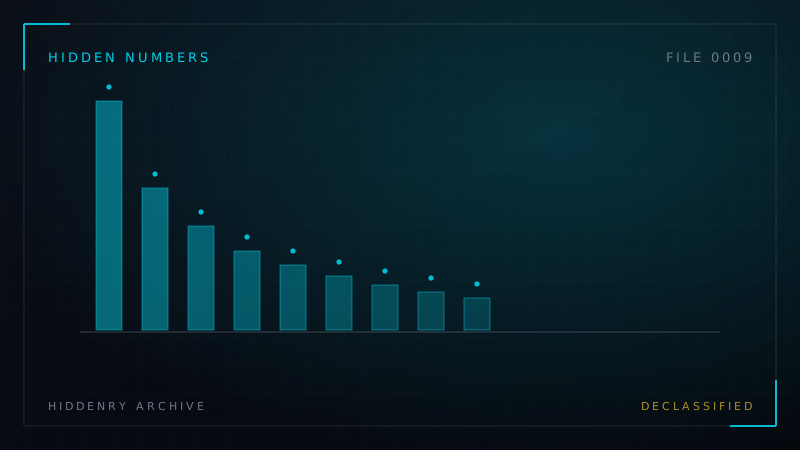 Hidden Numbers Entry #0004
Benford’s Law: why 1 leads the ledger
In real-world data, about 30% of numbers start with the digit 1 and only 4.6% start with 9. Fraud investigators use that gap as a lie detector.
MasterThe hidden part #0004Genuine numbers are unevenly distributed. Invented numbers are suspiciously even.
Numbers Open file
Annotations are reserved for archive members.
Sign in to annotate