The reason a currency without symbols raises spend
Remove the dollar sign and the number stops feeling like money. It becomes a score, and scores are spent differently from budgets.
Intuition test — answer before you read on
A restaurant removes dollar signs from its menu and spend rises. Why?
A restaurant prints its menu without currency symbols or decimal points: Steak 42, Salad 18. Average spend rises compared with identical menus that include the local currency sign. The prices are identical; the symbols that made them feel like money are absent.
What everyone sees
The omission looks like a design choice — a cleaner, more elegant menu. Diners may notice the absence of the sign but assume it makes no difference, because they know what 42 means. Knowing is not the same as feeling, and the feeling is what the menu changed.
What is actually happening
Yang, Kimes and Sessarego found that diners spent more when menus omitted the dollar sign, controlling for other factors. Prelec and Loewenstein described the pain of paying: the felt cost of a purchase, which varies with the salience of the price. A currency symbol makes the number explicitly monetary, which activates the pain-of-paying mechanism. Without the symbol, the number is still understood intellectually but is less viscerally connected to the idea of spending money, and the reduction in felt cost increases willingness to order.
Why it stays hidden
The mechanism hides because the diner’s knowledge has not changed. They still know 42 means forty-two dollars. But knowledge operates in one system and the pain of paying operates in another, and the symbol is a cue that bridges the two. Removing the cue leaves the knowledge intact and weakens the bridge, which is why the diner spends more without feeling less informed.
A currency symbol is not information. It is a pain cue. Remove it and the number stays; the flinch goes.
A currency symbol is not information. It is a pain cue. Remove it and the number stays; the flinch goes.
Collect this card
A currency symbol is not information. It is a pain cue. Remove it and the number stays; the flinch goes.
0 / 10,000 collected
Sources & further reading 3
- Yang, Kimes & Sessarego, "$ or Dollars: Effects of Menu-Price Formats on Restaurant Checks", Cornell Hospitality Report, 2009
- Prelec & Loewenstein, "The Red and the Black: Mental Accounting of Savings and Debt", Marketing Science, 1998
- Raghubir & Srivastava, "Monopoly Money: The Effect of Payment Coupling and Form on Spending Behavior", Journal of Experimental Psychology: Applied, 2008
Cross-references
Related files
-
No visual on fileStatistical Illusions Entry #0435
The reason a graph without zero can double an effect
Truncating the y-axis does not change the data. It changes the slope the eye sees, and the eye reads slope as magnitude before the mind reads the numbers.
MasterThe hidden part #0435A graph with correct data and a truncated axis is not lying about the numbers. It is lying about the shape.
Statistics Open file -
No visual on fileScarcity & Queues Entry #0460
The reason rationing changes what people want
A product that was adequate becomes desirable when restricted. The restriction changed the inference the buyer draws, not the product itself.
MasterThe hidden part #0460A quota does not just limit access. It changes the inference about what is being accessed. The product behind the restriction is perceived as the product that deserved the restriction.
Scarcity Open file -
 Hidden Numbers Entry #0004
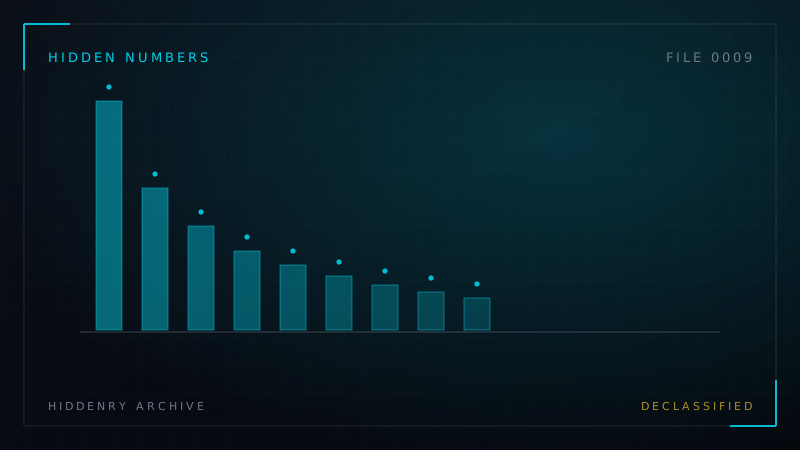
Benford’s Law: why 1 leads the ledger
In real-world data, about 30% of numbers start with the digit 1 and only 4.6% start with 9. Fraud investigators use that gap as a lie detector.
MasterThe hidden part #0004Genuine numbers are unevenly distributed. Invented numbers are suspiciously even.
Numbers Open file -
No visual on fileScarcity & Queues Entry #0455
Why one-per-customer raises the average purchase
A limit of two per customer raises the average quantity bought. The restriction is read as information about how many one ought to take.
MasterThe hidden part #0455A limit is not only a ceiling. It is a suggestion, and it usually sits above what the buyer had in mind.
Scarcity Open file
Annotations are reserved for archive members.
Sign in to annotate