The reason deadlines set by others are missed differently
A deadline the person chose binds more tightly than one imposed from outside. The difference is not in the calendar but in who owns the commitment.
Intuition test — answer before you read on
Why are self-set deadlines missed less often than imposed ones with the same date?
Two projects with identical scope receive identical deadlines. One deadline was chosen by the team, the other imposed by a manager. The self-set deadline is missed less often, and when it is missed, the overshoot is smaller.
What everyone sees
Both deadlines carry consequences: the manager’s version may carry a formal penalty, which should make it harder to miss. The observation that the self-set version binds more tightly contradicts the expectation that external enforcement is the stronger instrument.
What is actually happening
Ariely and Wertenbroch showed that self-imposed deadlines improved performance relative to externally imposed ones, despite being suboptimal in spacing. Locke and Latham’s goal-setting theory holds that commitment is a moderator of goal effectiveness, and commitment is higher when the goal is self-selected. Deci and Ryan’s self-determination theory identifies autonomy as a basic psychological need: tasks framed as chosen generate more sustained effort than tasks framed as assigned, even when the task itself is identical.
Why it stays hidden
The ownership effect hides because deadlines look like dates, and dates are the same regardless of who set them. The calendar does not distinguish between a self-set Tuesday and an imposed Tuesday. The difference is in the psychological contract: missing a self-set deadline is a failure of one’s own word, while missing an imposed deadline is a failure to comply with someone else’s, and the two carry different internal costs.
The date is the same. The ownership is different. A commitment made by the person who must keep it binds in a way that an instruction does not.
The date is the same. The ownership is different. A commitment made by the person who must keep it binds in a way that an instruction does not.
Collect this card
The date is the same. The ownership is different. A commitment made by the person who must keep it binds in a way that an instruction does not.
0 / 10,000 collected
Sources & further reading 3
- Ariely & Wertenbroch, "Procrastination, Deadlines, and Performance", Psychological Science, 2002
- Locke & Latham, "Building a Practically Useful Theory of Goal Setting and Task Motivation", American Psychologist, 2002
- Deci & Ryan, "Self-Determination Theory and the Facilitation of Intrinsic Motivation", American Psychologist, 2000
Cross-references
Related files
-
No visual on fileStatistical Illusions Entry #0435
The reason a graph without zero can double an effect
Truncating the y-axis does not change the data. It changes the slope the eye sees, and the eye reads slope as magnitude before the mind reads the numbers.
MasterThe hidden part #0435A graph with correct data and a truncated axis is not lying about the numbers. It is lying about the shape.
Statistics Open file -
No visual on fileScarcity & Queues Entry #0460
The reason rationing changes what people want
A product that was adequate becomes desirable when restricted. The restriction changed the inference the buyer draws, not the product itself.
MasterThe hidden part #0460A quota does not just limit access. It changes the inference about what is being accessed. The product behind the restriction is perceived as the product that deserved the restriction.
Scarcity Open file -
No visual on filePrice Psychology Entry #0360
The reason a currency without symbols raises spend
Remove the dollar sign and the number stops feeling like money. It becomes a score, and scores are spent differently from budgets.
MasterThe hidden part #0360A currency symbol is not information. It is a pain cue. Remove it and the number stays; the flinch goes.
Pricing Open file -
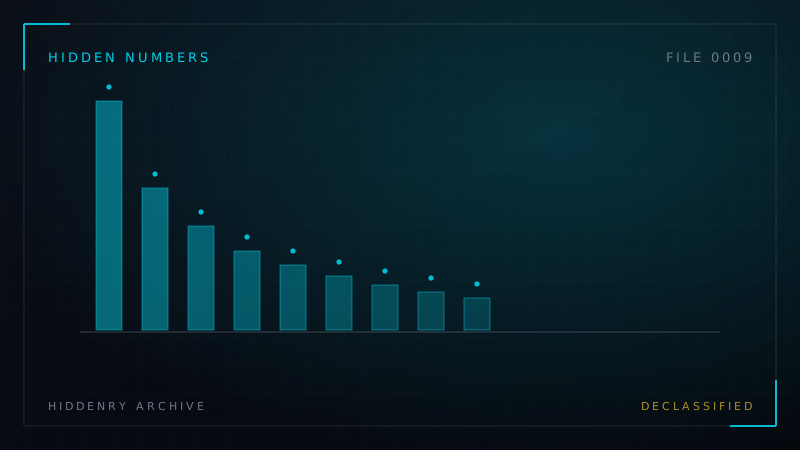 Hidden Numbers Entry #0004
Benford’s Law: why 1 leads the ledger
In real-world data, about 30% of numbers start with the digit 1 and only 4.6% start with 9. Fraud investigators use that gap as a lie detector.
MasterThe hidden part #0004Genuine numbers are unevenly distributed. Invented numbers are suspiciously even.
Numbers Open file
Annotations are reserved for archive members.
Sign in to annotate