The reason a dress code survives its own obsolescence
Nobody believes the tie improves work. Everybody wears one, because not wearing one sends a signal about willingness to comply that wearing one does not.
Intuition test — answer before you read on
Nobody in a firm believes ties improve work, yet the dress code persists. Why?
A professional firm requires suits and ties. Nobody in the firm believes attire affects the quality of work. The code persists, and the first person to drop it would not be making a fashion choice; they would be making a statement about their willingness to follow the group’s norms.
What everyone sees
Dress codes are dismissed as tradition or inertia: nobody got around to changing the rule. The possibility that the code is actively maintained by a signalling equilibrium — that compliance signals something valuable and defection signals something costly — is less intuitive, because the code is discussed in terms of aesthetics rather than information.
What is actually happening
Akerlof described conformity as a rational response to social norms when deviation carries a penalty. Bernheim modelled conformity as a signalling equilibrium in which agents adhere to a standard to avoid the inference that they are unwilling to comply. The dress code survives not because anyone values it intrinsically but because dropping it unilaterally sends the signal “I am willing to deviate from group norms,” which is read as a signal about broader reliability. Firms tolerate the code because removing it would require coordinated action, and no individual has the incentive to go first.
Why it stays hidden
The equilibrium hides because each individual’s compliance looks like a personal choice (or personal lack of interest in change). Nobody reports wearing a tie to avoid a negative inference; they report wearing it because they always have, or because it is expected. The signalling function operates below the narrative, and the narrative attributes the behaviour to habit rather than to strategy.
The code persists because dropping it unilaterally sends a signal about compliance that wearing it does not. Nobody needs to value the tie; they only need to fear what not wearing it says.
The code persists because dropping it unilaterally sends a signal about compliance that wearing it does not. Nobody needs to value the tie; they only need to fear what not wearing it says.
Collect this card
The code persists because dropping it unilaterally sends a signal about compliance that wearing it does not. Nobody needs to value the tie; they only need to fear what not wearing it says.
0 / 10,000 collected
Sources & further reading 3
- Bernheim, "A Theory of Conformity", Journal of Political Economy, 1994
- Akerlof, "A Theory of Social Custom, of Which Unemployment May Be One Consequence", Quarterly Journal of Economics, 1980
- Pesendorfer, "Design Innovation and Fashion Cycles", American Economic Review, 1995
Cross-references
Related files
-
No visual on fileStatistical Illusions Entry #0435
The reason a graph without zero can double an effect
Truncating the y-axis does not change the data. It changes the slope the eye sees, and the eye reads slope as magnitude before the mind reads the numbers.
MasterThe hidden part #0435A graph with correct data and a truncated axis is not lying about the numbers. It is lying about the shape.
Statistics Open file -
No visual on fileScarcity & Queues Entry #0460
The reason rationing changes what people want
A product that was adequate becomes desirable when restricted. The restriction changed the inference the buyer draws, not the product itself.
MasterThe hidden part #0460A quota does not just limit access. It changes the inference about what is being accessed. The product behind the restriction is perceived as the product that deserved the restriction.
Scarcity Open file -
No visual on filePrice Psychology Entry #0360
The reason a currency without symbols raises spend
Remove the dollar sign and the number stops feeling like money. It becomes a score, and scores are spent differently from budgets.
MasterThe hidden part #0360A currency symbol is not information. It is a pain cue. Remove it and the number stays; the flinch goes.
Pricing Open file -
 Hidden Numbers Entry #0004
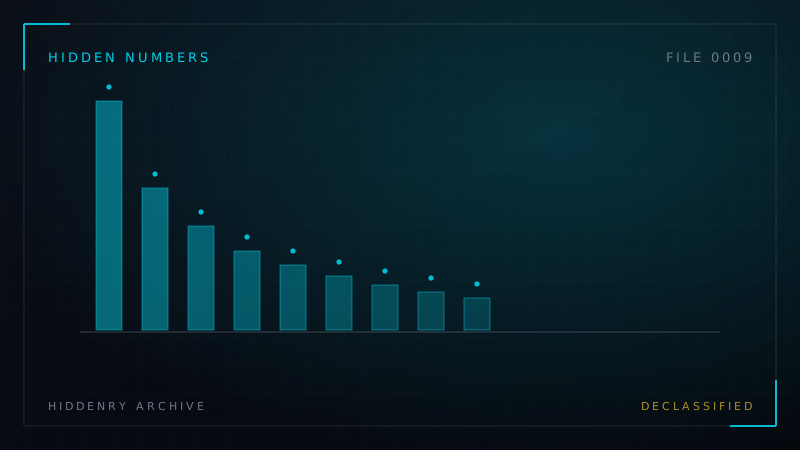
Benford’s Law: why 1 leads the ledger
In real-world data, about 30% of numbers start with the digit 1 and only 4.6% start with 9. Fraud investigators use that gap as a lie detector.
MasterThe hidden part #0004Genuine numbers are unevenly distributed. Invented numbers are suspiciously even.
Numbers Open file
Annotations are reserved for archive members.
Sign in to annotate