Why free options are consumed wastefully
A price does two jobs: it raises revenue and it sorts users by how much they need the thing. Remove the price and the second job stops being done.
Intuition test — answer before you read on
Why does an unpriced shared resource tend to be consumed beyond what need would justify?
Free internal tooling, unlimited leave, all-inclusive buffets and open office supplies share a pattern. Consumption rises faster than need, and the heaviest users are frequently not those with the strongest requirement. The resource is not abused by bad actors; it is consumed by ordinary people whose personal cost of taking one more unit has been set to zero.
What everyone sees
Waste under a free allocation is usually read as a character problem: some people take more than their share, so the answer is a policy reminder or a fair-use appeal. Appeals do reduce the most conspicuous overuse for a while. They do not change the arithmetic facing each individual, which is that the benefit of taking one more unit is private and the cost is spread across everyone.
What is actually happening
Hardin described the structure formally: where a resource is shared and access is unpriced, each participant gains the full value of an additional unit while bearing only a fraction of the depletion, so the individually sensible choice aggregates into collective exhaustion. Ostrom then showed the outcome is not inevitable, because durable commons impose rules, monitoring and graduated sanctions that reintroduce a cost for heavy use. Both accounts point at the same variable. A price is a filter as well as a charge, and when the filter is removed the queue fills with low-value demand that would never have paid to be there.
Why it stays hidden
The mechanism stays hidden because each individual act looks harmless and the harm arrives only as an aggregate. Nobody observes themselves depleting anything; they observe themselves taking a normal amount of something offered freely. The cost surfaces later as a shortage, a rationing rule or a withdrawal of the benefit, and by then it is attributed to bad management rather than to the absent filter.
A price is not only a charge. It is a filter that sorts demand by need, and free resources have no filter.
A price is not only a charge. It is a filter that sorts demand by need, and free resources have no filter.
Collect this card
A price is not only a charge. It is a filter that sorts demand by need, and free resources have no filter.
0 / 10,000 collected
Sources & further reading 2
- Hardin — the tragedy of the commons
- Ostrom — governing the commons
Cross-references
Related files
-
No visual on fileStatistical Illusions Entry #0435
The reason a graph without zero can double an effect
Truncating the y-axis does not change the data. It changes the slope the eye sees, and the eye reads slope as magnitude before the mind reads the numbers.
MasterThe hidden part #0435A graph with correct data and a truncated axis is not lying about the numbers. It is lying about the shape.
Statistics Open file -
No visual on fileScarcity & Queues Entry #0460
The reason rationing changes what people want
A product that was adequate becomes desirable when restricted. The restriction changed the inference the buyer draws, not the product itself.
MasterThe hidden part #0460A quota does not just limit access. It changes the inference about what is being accessed. The product behind the restriction is perceived as the product that deserved the restriction.
Scarcity Open file -
No visual on filePrice Psychology Entry #0360
The reason a currency without symbols raises spend
Remove the dollar sign and the number stops feeling like money. It becomes a score, and scores are spent differently from budgets.
MasterThe hidden part #0360A currency symbol is not information. It is a pain cue. Remove it and the number stays; the flinch goes.
Pricing Open file -
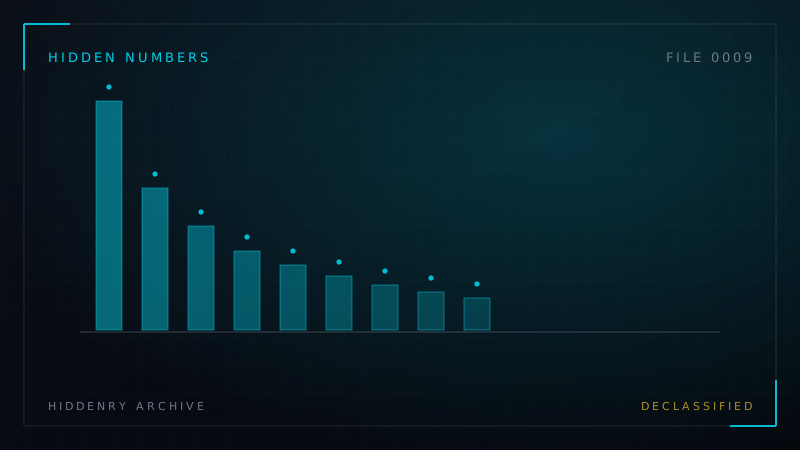 Hidden Numbers Entry #0004
Benford’s Law: why 1 leads the ledger
In real-world data, about 30% of numbers start with the digit 1 and only 4.6% start with 9. Fraud investigators use that gap as a lie detector.
MasterThe hidden part #0004Genuine numbers are unevenly distributed. Invented numbers are suspiciously even.
Numbers Open file
Annotations are reserved for archive members.
Sign in to annotate