The reason a leaderboard demotivates the middle
A ranking motivates whoever can plausibly move on it. For everyone whose position is settled, it removes the reason to try at all.
Intuition test — answer before you read on
Why can a public leaderboard lower total effort even while raising it at the top?
A sales board goes up. The top four compete harder, the bottom three panic, and the eleven people in the middle quietly return to whatever pace they were keeping before, having established in one glance that neither first place nor last place is available to them this quarter.
What everyone sees
A ranking is read as a general motivator, as though visibility of standing raised effort uniformly. It does not distribute that way. Its effect depends on whether a person’s position is contestable, and in any sizeable ranking most positions are not — the outcome is already legible from where they sit.
What is actually happening
Tournament theory, as developed by Lazear and Rosen, shows that effort under rank-order competition depends on the marginal effect of effort on the probability of changing rank, so incentive strength collapses wherever that probability is near zero at either end. Casas-Arce and Martínez-Jerez examined a sales tournament and found effort rising for contestants near the prize threshold and falling among those far behind, with the aggregate effect depending entirely on how many participants sat in the contestable band. The middle of a long board is the largest group and the one least able to move, which is why a device that intensifies competition for a handful can reduce total effort. Real-time dashboards sharpen this by making the hopelessness of a position continuously visible rather than quarterly.
Why it stays hidden
The loss hides because the visible response is the intended one. The top of the board does work harder, and that is the part managers watch, discuss and cite. Middle-of-board disengagement produces no incident, no complaint and no drop sharp enough to investigate — only a flat line that was flat before the board existed.
A ranking motivates only where position is contestable. For the settled middle it publishes the news that effort will not change the outcome.
A ranking motivates only where position is contestable. For the settled middle it publishes the news that effort will not change the outcome.
Collect this card
A ranking motivates only where position is contestable. For the settled middle it publishes the news that effort will not change the outcome.
0 / 10,000 collected
Sources & further reading 2
- Lazear & Rosen — rank-order tournaments as optimum labour contracts
- Casas-Arce & Martínez-Jerez — relative performance compensation, contests and dynamic incentives
Cross-references
Related files
-
No visual on fileStatistical Illusions Entry #0435
The reason a graph without zero can double an effect
Truncating the y-axis does not change the data. It changes the slope the eye sees, and the eye reads slope as magnitude before the mind reads the numbers.
MasterThe hidden part #0435A graph with correct data and a truncated axis is not lying about the numbers. It is lying about the shape.
Statistics Open file -
No visual on fileScarcity & Queues Entry #0460
The reason rationing changes what people want
A product that was adequate becomes desirable when restricted. The restriction changed the inference the buyer draws, not the product itself.
MasterThe hidden part #0460A quota does not just limit access. It changes the inference about what is being accessed. The product behind the restriction is perceived as the product that deserved the restriction.
Scarcity Open file -
No visual on filePrice Psychology Entry #0360
The reason a currency without symbols raises spend
Remove the dollar sign and the number stops feeling like money. It becomes a score, and scores are spent differently from budgets.
MasterThe hidden part #0360A currency symbol is not information. It is a pain cue. Remove it and the number stays; the flinch goes.
Pricing Open file -
 Hidden Numbers Entry #0004
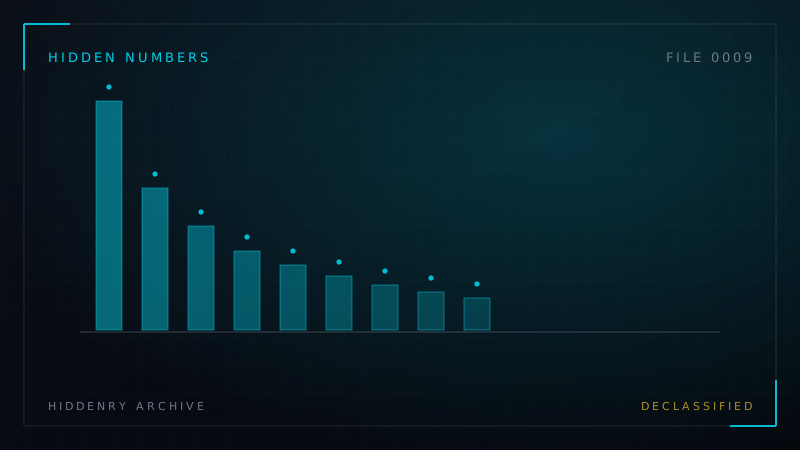
Benford’s Law: why 1 leads the ledger
In real-world data, about 30% of numbers start with the digit 1 and only 4.6% start with 9. Fraud investigators use that gap as a lie detector.
MasterThe hidden part #0004Genuine numbers are unevenly distributed. Invented numbers are suspiciously even.
Numbers Open file
Annotations are reserved for archive members.
Sign in to annotate