Filtered dossier

Entries

A declassified pattern in the Hiddenry archive.

  • 12 / 12
  • No visual on file
    Rhetoric & Omission Entry #0584

    Why the strongest point belongs second, not first

    The first point orients. The second convinces. Leading with the strongest evidence wastes it on an audience that does not yet know why it matters.

    Adept
    The hidden part #0584

    The first point sets the frame. The second point fills it. The strongest evidence belongs where the frame is ready to receive it.

    Open file
  • No visual on file
    Incentive Design Entry #0383

    The reason relative ranking beats absolute targets

    A fixed target stops motivating the moment it is met. A ranking has no ceiling, and it also has no protection against the loser competing on the wrong dimension.

    Adept
    The hidden part #0383

    A target has a ceiling and a ranking has none. Uncapped competition also has no cap on how it is pursued.

    Open file
  • No visual on file
    Market Signals Entry #0404

    The reason a company that advertises must be solvent

    The advertisement does not persuade because of what it says. It persuades because spending visibly on something that could fail is proof that failure is not expected.

    Adept
    The hidden part #0404

    Spend implies expected future revenue. The advertisement’s most persuasive argument is not what it says but how much it cost.

    Open file
  • No visual on file
    Price Psychology Entry #0362

    The reason personalised pricing feels like a penalty

    Two buyers pay different prices for the same item. The one who paid more does not see a market. They see a judgement about how much they were willing to lose.

    Adept
    The hidden part #0362

    Personalised pricing is efficient in aggregate and punitive in particular. The buyer who paid more does not feel optimised. They feel targeted.

    Open file
  • No visual on file
    Market Signals Entry #0403

    Why a guarantee is a statement about failure rates

    A company that offers a long warranty is not being generous. It is telling you, in financial language, how rarely it expects to pay.

    Novice
    The hidden part #0403

    Confidence is expressed in liability. The warranty says less about what will happen to the buyer and more about what the company already knows will not.

    Open file
  • Why aeroplane windows have a tiny hole
    Hidden Mechanics Entry #0007

    Why aeroplane windows have a tiny hole

    There are three panes in that window and a deliberate hole in the middle one. It decides which pane is allowed to break.

    Master
    The hidden part #0007

    The hole chooses the victim. It hands the entire cabin pressure load to the outer pane.

    Open file
  • No visual on file
    Price Psychology Entry #0361

    Why a price ending in zero suits luxury

    A round number implies the price was set by authority. A precise number implies it was set by calculation. The first suits a product that is above calculation.

    Novice
    The hidden part #0361

    A round price says the seller did not haggle. A precise price says the seller calculated. Luxury cannot afford to look like it calculated.

    Open file
  • No visual on file
    Price Psychology Entry #0358

    The reason unbundling raises revenue and lowers trust

    Splitting one price into a base plus additions raises the total collected and makes comparison harder. Buyers notice the second effect and attribute it to the seller.

    Adept
    The hidden part #0358

    Comparison happens on the compared dimension. Cost moves to wherever nobody is looking, and the total arrives last.

    Open file
  • No visual on file
    Incentive Design Entry #0378

    Why a fine can act as a price

    Before the fine existed, guilt kept the behaviour in check. After the fine was introduced, the behaviour increased — because paying made it permissible.

    Novice
    The hidden part #0378

    Priced misbehaviour becomes permitted misbehaviour. The fine did not add a cost; it removed a prohibition.

    Open file
  • No visual on file
    Price Psychology Entry #0360

    The reason a currency without symbols raises spend

    Remove the dollar sign and the number stops feeling like money. It becomes a score, and scores are spent differently from budgets.

    Master
    The hidden part #0360

    A currency symbol is not information. It is a pain cue. Remove it and the number stays; the flinch goes.

    Open file
  • No visual on file
    Price Psychology Entry #0357

    Why anchoring works on the price you never pay

    A struck-through figure that nobody was charged still sets the standard the real price is judged against. Its only function is to be higher.

    Novice
    The hidden part #0357

    The anchor works by being adjacent, not by being true. A number nobody paid still sets the scale for the number you do.

    Open file
  • The Birthday Paradox: 23 people, even odds
    Hidden Numbers Entry #0006

    The Birthday Paradox: 23 people, even odds

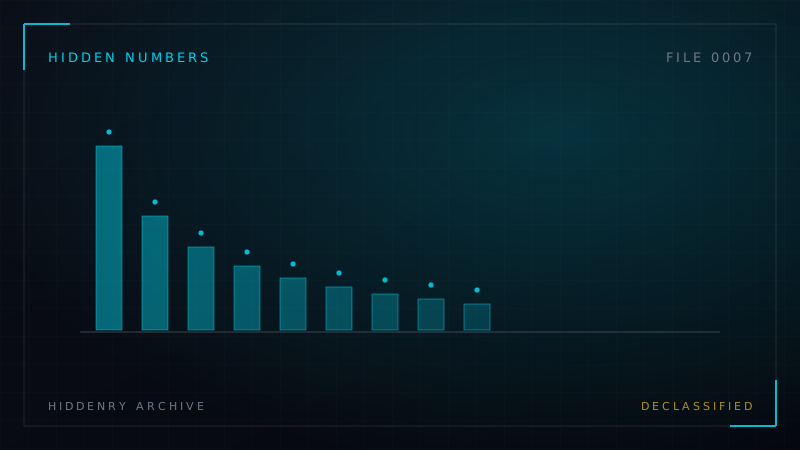
    Put 23 strangers in a room and it is a coin flip whether two of them share a birthday. Your intuition says 180. Your intuition is counting the wrong thing.

    Adept
    The hidden part #0006

    You are not counting people. You are counting pairs — and pairs grow much faster than people.
    Open file