The reason a certification matters more in opaque markets
Where buyers can inspect, a badge adds nothing. Its value comes entirely from the inspection it stands in for, and rises as inspection gets harder.
Intuition test — answer before you read on
Why does certification carry more weight in some markets than others?
Nobody asks for a certificate when buying apples. The buyer looks at the apples. Ask what guarantees the competence of a structural surveyor, the safety of a supply chain or the training of an anaesthetist and the conversation is immediately about accreditation, because there is nothing to look at.
What everyone sees
Certification is read as a mark of superior quality, which invites the reasonable objection that certified providers are often no better than uncertified ones. The objection targets the wrong function. A badge is not primarily a quality claim; it is a substitute for an inspection the buyer cannot perform, and its worth tracks how unavailable that inspection is.
What is actually happening
Akerlof showed that where quality is unobservable at the point of sale and buyers cannot distinguish types, the market price converges to the value of the worse type and higher-quality sellers withdraw — producing the collapse the badge exists to prevent. Nelson’s distinction between search and experience goods identifies exactly where badges are valuable: for search goods, whose properties can be checked before purchase, the buyer needs nothing; for experience and credence goods, whose quality is revealed only after purchase or never, the buyer has no alternative. Dranove and Jin’s review of quality disclosure adds the necessary caution: certification works only where the certifier is itself credible and its incentives are not aligned with the certified, and many schemes fail this test.
Why it stays hidden
The dependence hides because badges are displayed identically in both kinds of market. The same visual grammar — seal, wording, gold border — appears on the accreditation of a surgical practice and on the trust badge of a checkout page, and the second one is copying the appearance of the first without the inspection that made it worth anything.
A badge is worth exactly what the inspection it replaces would have been worth. Where the buyer could just look, it is worth nothing.
A badge is worth exactly what the inspection it replaces would have been worth. Where the buyer could just look, it is worth nothing.
Collect this card
A badge is worth exactly what the inspection it replaces would have been worth. Where the buyer could just look, it is worth nothing.
0 / 10,000 collected
Sources & further reading 2
- Akerlof — the market for lemons: quality uncertainty and the market mechanism
- Dranove & Jin — quality disclosure and certification: theory and practice
Cross-references
Related files
-
No visual on fileStatistical Illusions Entry #0435
The reason a graph without zero can double an effect
Truncating the y-axis does not change the data. It changes the slope the eye sees, and the eye reads slope as magnitude before the mind reads the numbers.
MasterThe hidden part #0435A graph with correct data and a truncated axis is not lying about the numbers. It is lying about the shape.
Statistics Open file -
No visual on fileScarcity & Queues Entry #0460
The reason rationing changes what people want
A product that was adequate becomes desirable when restricted. The restriction changed the inference the buyer draws, not the product itself.
MasterThe hidden part #0460A quota does not just limit access. It changes the inference about what is being accessed. The product behind the restriction is perceived as the product that deserved the restriction.
Scarcity Open file -
No visual on filePrice Psychology Entry #0360
The reason a currency without symbols raises spend
Remove the dollar sign and the number stops feeling like money. It becomes a score, and scores are spent differently from budgets.
MasterThe hidden part #0360A currency symbol is not information. It is a pain cue. Remove it and the number stays; the flinch goes.
Pricing Open file -
 Hidden Numbers Entry #0004
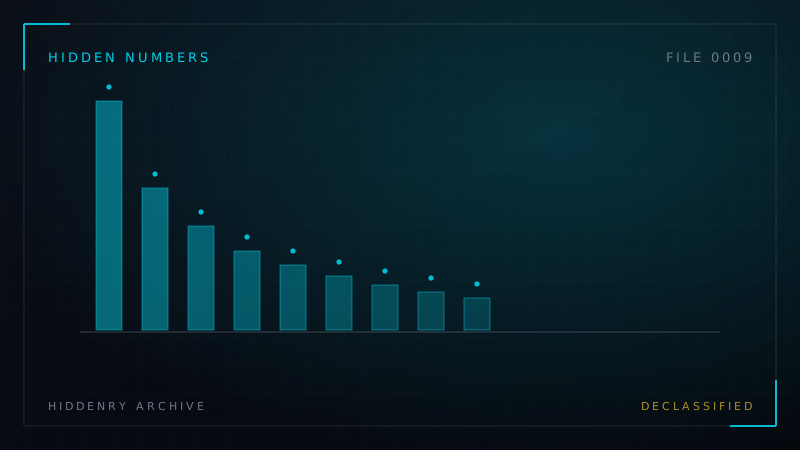
Benford’s Law: why 1 leads the ledger
In real-world data, about 30% of numbers start with the digit 1 and only 4.6% start with 9. Fraud investigators use that gap as a lie detector.
MasterThe hidden part #0004Genuine numbers are unevenly distributed. Invented numbers are suspiciously even.
Numbers Open file
Annotations are reserved for archive members.
Sign in to annotate