Why commission changes advice more than dishonesty
Advisers paid by outcome rarely lie. They notice different options, so the incentive does its work through attention rather than through deceit.
Intuition test — answer before you read on
Estate agents were compared selling clients’ homes and their own. What was found?
An estate agent selling their own house waits longer than when selling yours, and ends with a higher price. No fraud is involved. A commission that is a small share of the price but the whole share of the effort simply makes the last week of patience worth less to the agent than to the owner.
What everyone sees
Conflicts of interest are discussed as an honesty problem, which makes disclosure the obvious remedy. Tell the client how you are paid and an informed client can discount the advice. Regulators like this because it is cheap, and advisers like it because it is survivable.
What is actually happening
The measured effects run through judgement rather than through lying. Compared with client sales, agent-owned homes stayed on the market roughly ten days longer and sold for a few per cent more. Work on disclosure found it can make matters worse: the adviser feels licensed by having confessed, while the client finds it socially costly to act on the warning they were just given.
Why it stays hidden
Nothing here requires bad faith, so nothing here trips the defences built for bad faith. The adviser passes every honesty test, because the recommendation offered is genuinely the one that occurred to them first. That is why the useful question to put to an adviser is not whether they are honest, but how their last hour of attention is priced.
An incentive does not need to corrupt anyone. It only needs to change which option comes to mind first.
An incentive does not need to corrupt anyone. It only needs to change which option comes to mind first.
Collect this card
An incentive does not need to corrupt anyone. It only needs to change which option comes to mind first.
0 / 10,000 collected
Sources & further reading 3
- Levitt & Syverson, "Market Distortions When Agents Are Better Informed", Review of Economics and Statistics, 2008
- Cain, Loewenstein & Moore, "The Dirt on Coming Clean: Perverse Effects of Disclosing Conflicts of Interest", Journal of Legal Studies, 2005
- Inderst & Ottaviani, "Competition through Commissions and Kickbacks", American Economic Review, 2012
Cross-references
Related files
-
No visual on fileStatistical Illusions Entry #0435
The reason a graph without zero can double an effect
Truncating the y-axis does not change the data. It changes the slope the eye sees, and the eye reads slope as magnitude before the mind reads the numbers.
MasterThe hidden part #0435A graph with correct data and a truncated axis is not lying about the numbers. It is lying about the shape.
Statistics Open file -
No visual on fileScarcity & Queues Entry #0460
The reason rationing changes what people want
A product that was adequate becomes desirable when restricted. The restriction changed the inference the buyer draws, not the product itself.
MasterThe hidden part #0460A quota does not just limit access. It changes the inference about what is being accessed. The product behind the restriction is perceived as the product that deserved the restriction.
Scarcity Open file -
No visual on filePrice Psychology Entry #0360
The reason a currency without symbols raises spend
Remove the dollar sign and the number stops feeling like money. It becomes a score, and scores are spent differently from budgets.
MasterThe hidden part #0360A currency symbol is not information. It is a pain cue. Remove it and the number stays; the flinch goes.
Pricing Open file -
 Hidden Numbers Entry #0004
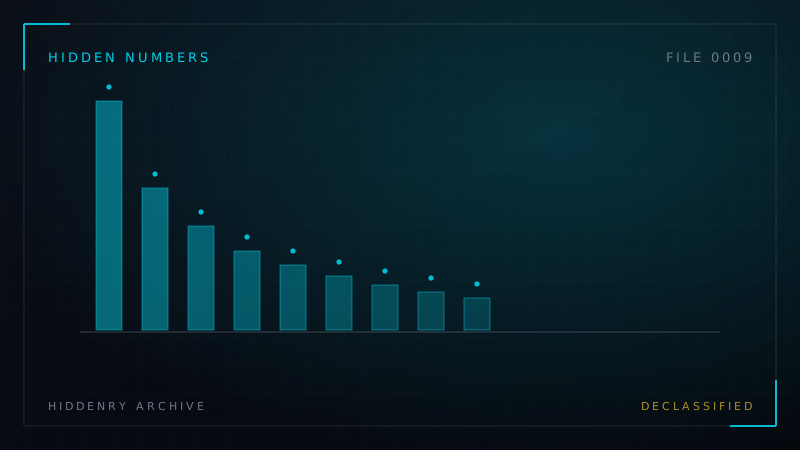
Benford’s Law: why 1 leads the ledger
In real-world data, about 30% of numbers start with the digit 1 and only 4.6% start with 9. Fraud investigators use that gap as a lie detector.
MasterThe hidden part #0004Genuine numbers are unevenly distributed. Invented numbers are suspiciously even.
Numbers Open file
Annotations are reserved for archive members.
Sign in to annotate