Skip to the archive contents
Archive status:
Open
Declassified
1,042 / 10,000
Clearance
Visitor
1,042 entries declassified
All 12
Logic 0
Mechanics 0
Numbers 3
Words 0
Bias 0
Decisions 0
Paradox 0
Attention 0
Social Proof 0
Choice 0
Persuasion 0
Platforms 0
Habit 0
Negotiation 0
Pricing 2
Incentives 1
Signals 4
Statistics 1
Scarcity 1
Brand 0
Framing 0
Narrative 0
Naming 0
Rhetoric 0
Rewards 0
Progress 0
Competition 0
Engagement 0
Achievements 0
Priming 0
Emotions 0
Attention Cap. 0
Recall 0
Fatigue 0
Tokenomics 0
Trust 0
Yield 0
Governance 0
Markets 0
Color 0
Sound 0
Touch 0
Scent 0
Space 0
12 / 12
Hidden Numbers
Entry #0006
Put 23 strangers in a room and it is a coin flip whether two of them share a birthday. Your intuition says 180. Your intuition is counting the wrong thing.
The hidden part
#0006
You are not counting people. You are counting pairs — and pairs grow much faster than people.
Reveal the hidden insight of The Birthday Paradox: 23 people, even odds
↻
No visual on file
Price Psychology
Entry #0360
Remove the dollar sign and the number stops feeling like money. It becomes a score, and scores are spent differently from budgets.
The hidden part
#0360
A currency symbol is not information. It is a pain cue. Remove it and the number stays; the flinch goes.
Reveal the hidden insight of The reason a currency without symbols raises spend
↻
No visual on file
Price Psychology
Entry #0359
The first unit is priced to attract. The second is priced to profit. The buyer who came for the bargain discovers the margin at the refill.
The hidden part
#0359
The first unit is an invitation. The second is the business. The margin lives where the comparison ended.
Reveal the hidden insight of Why the second unit is where the margin lives
↻
Hidden Numbers
Entry #0005
$9.99 is not one cent cheaper than $10. It is one whole digit cheaper — and the digit is the part you actually read.
The hidden part
#0005
You read prices left to right and stop early. The 99 arrives after you have already decided.
Reveal the hidden insight of Why every price ends in 99
↻
Hidden Numbers
Entry #0004
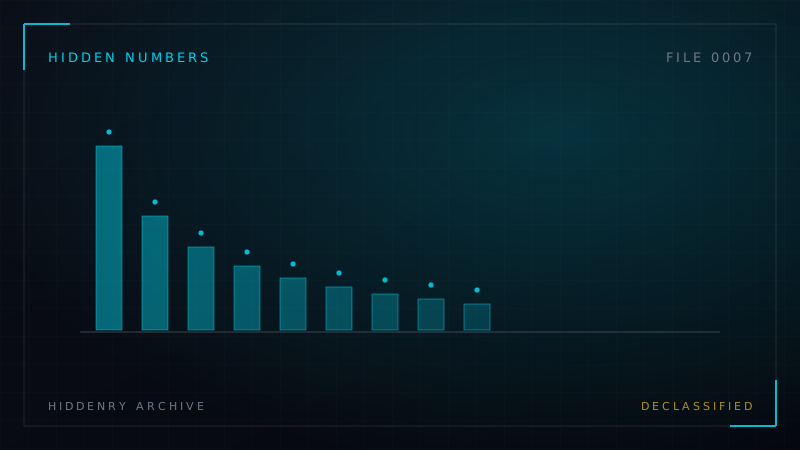
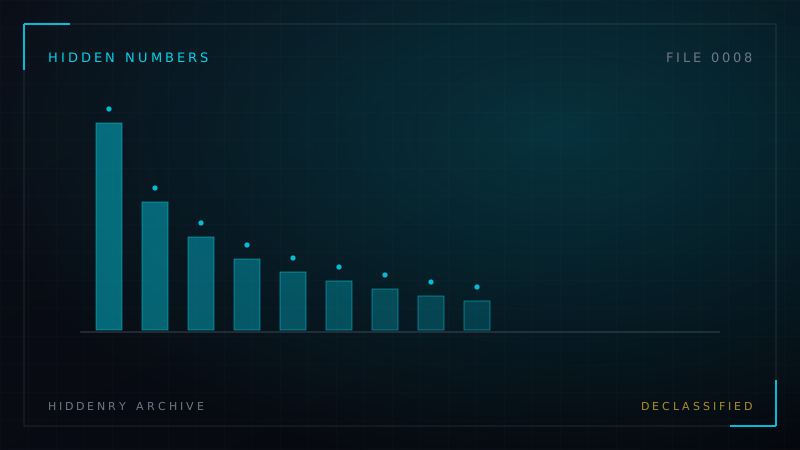
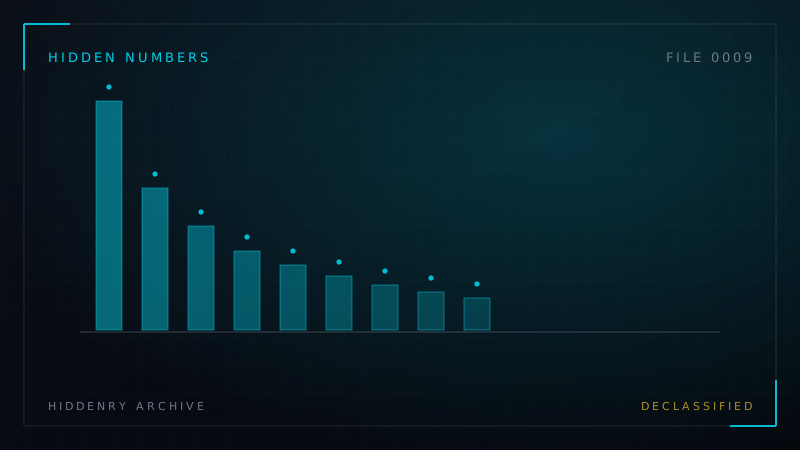
In real-world data, about 30% of numbers start with the digit 1 and only 4.6% start with 9. Fraud investigators use that gap as a lie detector.
The hidden part
#0004
Genuine numbers are unevenly distributed. Invented numbers are suspiciously even.
Reveal the hidden insight of Benford’s Law: why 1 leads the ledger
↻
No visual on file
Scarcity & Queues
Entry #0455
A limit of two per customer raises the average quantity bought. The restriction is read as information about how many one ought to take.
The hidden part
#0455
A limit is not only a ceiling. It is a suggestion, and it usually sits above what the buyer had in mind.
Reveal the hidden insight of Why one-per-customer raises the average purchase
↻
No visual on file
Statistical Illusions
Entry #0428
A test that is right ninety-nine times in a hundred can still be wrong about most of the cases it flags, and simple arithmetic shows why.
The hidden part
#0428
Accuracy is a property of the test. Whether an alert is right also depends on how rare the thing is.
Reveal the hidden insight of Why a ninety-nine per cent accurate test is usually wrong
↻
No visual on file
Incentive Design
Entry #0380
Advisers paid by outcome rarely lie. They notice different options, so the incentive does its work through attention rather than through deceit.
The hidden part
#0380
An incentive does not need to corrupt anyone. It only needs to change which option comes to mind first.
Reveal the hidden insight of Why commission changes advice more than dishonesty
↻
No visual on file
Market Signals
Entry #0412
A verifiable particular costs nothing to add and everything to fake. Its presence is read as a signal that the rest is also checkable.
The hidden part
#0412
A checkable detail is cheap to provide truthfully and expensive to fabricate. Its presence signals that the rest is willing to be checked.
Reveal the hidden insight of The reason an unnecessary detail makes a claim believable
↻
No visual on file
Market Signals
Entry #0411
Offering time for free implies the provider expects the meeting to convert. The confidence is inferred from the cost absorbed, not from anything said.
The hidden part
#0411
Absorbing a cost implies expecting to recover it. The free session is read as a statement: I know what will happen when you see the work.
Reveal the hidden insight of Why a free consultation signals confidence
↻
No visual on file
Market Signals
Entry #0410
Nobody believes the tie improves work. Everybody wears one, because not wearing one sends a signal about willingness to comply that wearing one does not.
The hidden part
#0410
The code persists because dropping it unilaterally sends a signal about compliance that wearing it does not. Nobody needs to value the tie; they only need to fear what not wearing it says.
Reveal the hidden insight of The reason a dress code survives its own obsolescence
↻
No visual on file
Market Signals
Entry #0409
A title is visible to everyone the holder meets. A salary is visible to nobody. The signal that travels is the one that shapes reputation.
The hidden part
#0409
A salary is private. A title is public. The public signal shapes the market’s estimate and sets the anchor for the next offer.
Reveal the hidden insight of Why a job title conveys more than a salary
↻
No files under that classification
Nothing in this pillar has been declassified on this page yet. Try another pillar.
Back to top