The reason a founder’s departure is read before it is explained
The statement arrives with the news, and the market ignores it. What an informed party does is treated as evidence; what they say is not.
Intuition test — answer before you read on
Why is a founder’s exit interpreted independently of the reasons given?
The announcement is warm, planned and full of gratitude. Within an hour, employees are updating their profiles, two competitors have called the same three customers, and the reading is settled long before anybody has evaluated the succession plan mentioned in paragraph four.
What everyone sees
The explanation is expected to govern the interpretation, which is why so much effort goes into drafting it. It does not govern anything. Observers discount statements that the speaker would make regardless of the truth, and every departure statement is warm, so warmth carries no information at all.
What is actually happening
Leland and Pyle showed that where insiders hold information outsiders lack, the insider’s own retained stake functions as the credible signal, because it is costly and cannot be misrepresented in the way a statement can. Crawford and Sobel’s analysis of strategic information transmission gives the general result: when the sender’s interests are known to diverge from the receiver’s, cheap messages convey little, and the receiver rationally attends to actions instead. A departure is an action taken by the party with the most information about the firm’s prospects, and it is expensive — in equity, in reputation, in optionality. The accompanying language costs nothing, so it is filtered out on arrival.
Why it stays hidden
The asymmetry hides because the statement is what gets published, quoted and archived. Coverage reproduces the wording, so the record shows an orderly transition explained in reasonable terms. The reading that actually spread through the market happened in private messages the same afternoon and left no citable trace.
A departure is a costly action by the best-informed party. The statement attached to it is free, and free statements are filtered out on arrival.
A departure is a costly action by the best-informed party. The statement attached to it is free, and free statements are filtered out on arrival.
Collect this card
A departure is a costly action by the best-informed party. The statement attached to it is free, and free statements are filtered out on arrival.
0 / 10,000 collected
Sources & further reading 2
- Leland & Pyle — informational asymmetries, financial structure and financial intermediation
- Crawford & Sobel — strategic information transmission
Cross-references
Related files
-
No visual on fileStatistical Illusions Entry #0435
The reason a graph without zero can double an effect
Truncating the y-axis does not change the data. It changes the slope the eye sees, and the eye reads slope as magnitude before the mind reads the numbers.
MasterThe hidden part #0435A graph with correct data and a truncated axis is not lying about the numbers. It is lying about the shape.
Statistics Open file -
No visual on fileScarcity & Queues Entry #0460
The reason rationing changes what people want
A product that was adequate becomes desirable when restricted. The restriction changed the inference the buyer draws, not the product itself.
MasterThe hidden part #0460A quota does not just limit access. It changes the inference about what is being accessed. The product behind the restriction is perceived as the product that deserved the restriction.
Scarcity Open file -
No visual on filePrice Psychology Entry #0360
The reason a currency without symbols raises spend
Remove the dollar sign and the number stops feeling like money. It becomes a score, and scores are spent differently from budgets.
MasterThe hidden part #0360A currency symbol is not information. It is a pain cue. Remove it and the number stays; the flinch goes.
Pricing Open file -
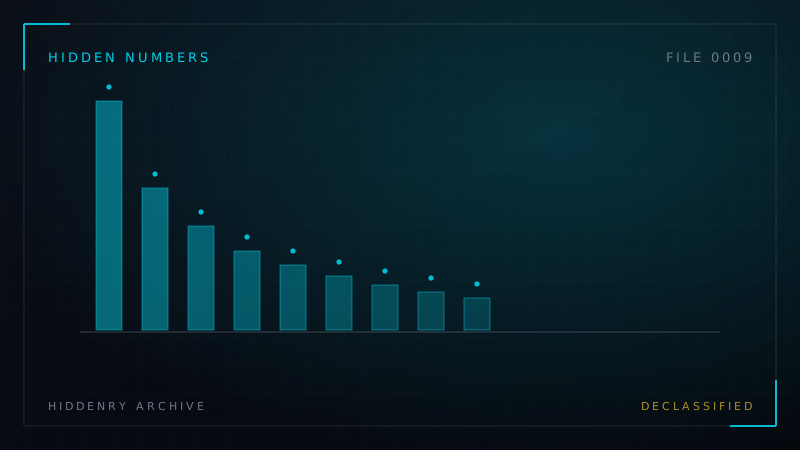 Hidden Numbers Entry #0004
Benford’s Law: why 1 leads the ledger
In real-world data, about 30% of numbers start with the digit 1 and only 4.6% start with 9. Fraud investigators use that gap as a lie detector.
MasterThe hidden part #0004Genuine numbers are unevenly distributed. Invented numbers are suspiciously even.
Numbers Open file
Annotations are reserved for archive members.
Sign in to annotate