The reason a premium tier nobody buys is profitable
Its purpose is not to sell. Standing at the top of the list, it makes the middle option the moderate choice instead of the expensive one.
Intuition test — answer before you read on
Why can a premium tier with almost no sales still increase total revenue?
The enterprise plan converts at under one per cent and has survived four pricing reviews. Remove it and revenue falls, because the plan below it stops being the sensible middle and becomes the most expensive thing on the page.
What everyone sees
A tier is judged by its own sales, so a tier nobody buys looks like clutter. That treats each option as independent. Options are evaluated against each other, and an unsold option can be doing more work than a sold one by changing where the middle sits.
What is actually happening
Huber, Payne and Puto demonstrated that adding an alternative which is clearly worse than an existing option — and therefore should never be chosen — raises the share of the option that dominates it, a violation of the assumption that adding choices cannot help a specific competitor. Wernerfelt’s reconstruction of the compromise effect gives a reason the behaviour is not simply an error: when buyers are uncertain about their own valuations, the middle option is a rational inference about what people like them typically need, so the position of the extremes carries genuine information. Either way the top tier earns its place on the page without earning revenue, and its removal changes the set that the remaining tiers are judged inside.
Why it stays hidden
The function hides because attribution runs by line item. Dashboards report revenue per plan, and the top tier reports nearly none, so it is proposed for deletion at every review. Its contribution appears as the middle tier’s conversion rate, which is credited to the middle tier.
An option can earn its place by shaping the set rather than by selling. Judged alone, it always looks removable.
An option can earn its place by shaping the set rather than by selling. Judged alone, it always looks removable.
Collect this card
An option can earn its place by shaping the set rather than by selling. Judged alone, it always looks removable.
0 / 10,000 collected
Sources & further reading 2
- Huber, Payne & Puto — adding asymmetrically dominated alternatives: violations of regularity
- Wernerfelt — a rational reconstruction of the compromise effect
Cross-references
Related files
-
No visual on fileStatistical Illusions Entry #0435
The reason a graph without zero can double an effect
Truncating the y-axis does not change the data. It changes the slope the eye sees, and the eye reads slope as magnitude before the mind reads the numbers.
MasterThe hidden part #0435A graph with correct data and a truncated axis is not lying about the numbers. It is lying about the shape.
Statistics Open file -
No visual on fileScarcity & Queues Entry #0460
The reason rationing changes what people want
A product that was adequate becomes desirable when restricted. The restriction changed the inference the buyer draws, not the product itself.
MasterThe hidden part #0460A quota does not just limit access. It changes the inference about what is being accessed. The product behind the restriction is perceived as the product that deserved the restriction.
Scarcity Open file -
No visual on filePrice Psychology Entry #0360
The reason a currency without symbols raises spend
Remove the dollar sign and the number stops feeling like money. It becomes a score, and scores are spent differently from budgets.
MasterThe hidden part #0360A currency symbol is not information. It is a pain cue. Remove it and the number stays; the flinch goes.
Pricing Open file -
 Hidden Numbers Entry #0004
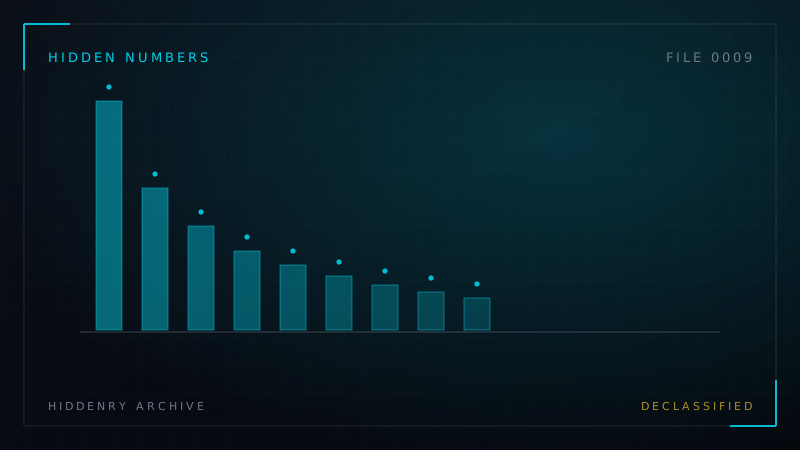
Benford’s Law: why 1 leads the ledger
In real-world data, about 30% of numbers start with the digit 1 and only 4.6% start with 9. Fraud investigators use that gap as a lie detector.
MasterThe hidden part #0004Genuine numbers are unevenly distributed. Invented numbers are suspiciously even.
Numbers Open file
Annotations are reserved for archive members.
Sign in to annotate